
Nuxt features: Use these if you want to build modern websites

By Arso Stojović•January 15, 2026•8 min read
In the fast-paced world of web development, Nuxt CMS demonstrates a seamless content management solution essential for delivering dynamic and engaging user experiences.
By harnessing the strengths of Nuxt.js, a robust framework for building Vue.js applications, and the efficiency of a content management system, businesses and developers can take control of their content like never before.
I already wrote about why to use CMS for Nuxt, so in this blog, I will explore the benefits and strategies of integrating Nuxt.js with a CMS. I will focus on the game-changing concept of Nuxt CMS.
How Nuxt features empower CMS?
It is not without reason that Nuxt.js is one of the favorite frameworks with which many developers work and build Nuxt websites and applications.
Nuxt.js empowers CMS in several ways, providing a solid foundation for building powerful and efficient content management solutions. Here are some key ways Nuxt.js empowers CMS:
Server-side rendering
Nuxt.js has built-in support for server-side rendering, enabling CMS applications to generate fully-rendered HTML on the server before sending it to the client.

SSR improves performance, allowing search engines to index content effectively and enhancing SEO by providing search engine-friendly pages. With Nuxt.js, CMS applications can deliver dynamic and optimized content to users, ensuring seamless browsing.
Code-splitting
Each route and page is automatically split into smaller chunks using Nuxt.js. This means that only the components that are needed for the page are loaded when the user visits it. That significantly improves performance and allows the user to interact with the page sooner.

Modular architecture

Nuxt.js follows a modular architecture, allowing you to break your CMS application into reusable modules, components, and plugins. This modularity simplifies the development process, making it easier to manage and organize different aspects of your CMS, such as:
user management
content types
authentication
permissions
You can create reusable components and modules, promoting code reuse and enabling it efficient to build and maintain complex CMS functionality.
Layouts and components
Nuxt.js allows you to define reusable layouts and components across CMS. This modular approach simplifies content management by separating content presentation from content creation. You can define different layouts for different types of content or create reusable components for common elements like headers, footers, or sidebars.
Flexible routing and navigation

Nuxt.js provides a flexible routing system that allows you to define CMS routes based on your content structure. This flexibility enables you to create dynamic routes matching your CMS structure, making navigating and accessing content easy. You can define nested routes, custom routes, and dynamic routes, providing a seamless and intuitive user experience for managing and accessing content within the CMS.
Async data fetching
Nuxt.js offers the ability to fetch data asynchronously during server-side rendering through its asyncData method. This feature is beneficial for CMS applications, as it allows you to fetch content from your CMS or external APIs before rendering the page. By pre-fetching data, you can ensure that the page is rendered with the necessary content, improving performance and user experience.
Global State Management with Nuxt
In the past, Vuex was the standard solution for managing global state in Vue and Nuxt applications. However, Vuex is no longer the preferred approach in modern Nuxt projects.
Today, Nuxt offers powerful state management capabilities out of the box, without requiring additional libraries or complex configuration.
useState and Composables
Nuxt provides useState and composables as native tools for managing shared and global state across your application.
These tools:
work seamlessly with SSR
require no additional packages
offer a simple and predictable API
For most Nuxt CMS use cases, such as content data, UI state, authentication flags, or feature toggles, useState and composables are more than sufficient.
Pinia as the Official Recommendation
For larger and more complex applications, Pinia is now the officially recommended state management solution by the Vue team.
Pinia offers:
a modern API
excellent TypeScript support
improved developer experience
However, for many CMS-driven Nuxt projects, Pinia can be unnecessary overhead. The flexibility to choose between built-in state tools and Pinia allows developers to scale only when needed.
Middleware for custom logic
Nuxt.js supports middleware, which can be used to implement custom logic and control various aspects of your CMS application.

Middleware functions can be used for authentication, authorization, and data manipulation. You can define global middleware or apply middleware to specific routes, providing flexibility and control over CMS functionality and operations. In a nutshell, middlewares are functions that are executed before navigating to a particular route".
Extensibility and integration

Nuxt.js is highly extensible and can be easily integrated with various CMS platforms, APIs, and third-party libraries. This allows you to leverage existing CMS systems or build custom CMS solutions that fit your specific requirements.
Rich Vue and Nuxt ecosystem
The Vue and Nuxt ecosystem has evolved into one of the richest frontend ecosystems available today.
Nuxt offers a massive collection of official and community-driven modules that simplify development and extend functionality without unnecessary complexity.
You can explore available modules here: https://nuxt.com/modules
BCMS Nuxt Module
BCMS is part of this ecosystem and is available as a dedicated Nuxt module.
The BCMS Nuxt module provides a simple, developer-friendly approach to connecting BCMS with Nuxt, allowing you to:
fetch structured content via composables
work seamlessly with SSR and static generation
keep content logic decoupled from UI components
This integration has been actively maintained and refined over the past months, making BCMS one of the easiest CMS solutions to pair with Nuxt today.
Nuxt CMS: Integration that manages content in a pretty component-driven way
Are you looking to efficiently manage your content in a visually appealing and component-driven manner? Look no further than Nuxt CMS integration. With Nuxt CMS, you can have seamless and dynamic content management.
Nuxt CMS offers a comprehensive solution that leverages Nuxt.js modular architecture, empowering you to organize and manage your content in an easy-to-use, component-based way.
Whether creating reusable components, defining dynamic routes, or implementing server-side rendering for optimized SEO, Nuxt CMS ensures your content is easily controlled and beautifully presented.
Read more about it: Why BCMS is the Best CMS for Nuxt
Nuxt and CMS features that have real power
Content editing and management
CMS provides an intuitive interface for content editors and administrators to create, update, and manage content without technical knowledge. By integrating Nuxt.js with a CMS, you can leverage content editing capabilities, allowing non-technical users to control website content easily. They can change text, images, videos, and other media assets through the CMS's user-friendly interface.
Separation of concerns
Nuxt CMS allows you to separate content management and frontend development concerns. Content editors can create and manage content through the CMS, while developers can focus on implementing frontend functionality and user experience using Nuxt.js. This separation improves collaboration between content creators and developers, as they can work independently and simultaneously.
Nuxt makes real-time updates really effortless
CMSs by their core nature, provide real-time content updates, allowing changes made in the CMS to be immediately reflected on the website. By integrating Nuxt.js with a CMS that supports real-time updates, you can ensure that your Nuxt.js application always displays the most up-to-date content without a page refresh. This is particularly useful for news sites, blogs, or any application where real-time content updates are critical.
Boost SEO rankings with Nuxt
Nuxt CMS provides built-in SEO features or plugins that optimize your content for search engines. By integrating Nuxt.js with a CMS, you can benefit from these SEO capabilities. This will ensure that your website's content is properly structured, meta tags are optimized, and URLs are search engine friendly. Making your content SEO-friendly improves your website's visibility and ranking in search engine results pages.
Image optimization
Nuxt.js has image optimization built-in; in a couple of steps, installation is done, and your images are automatically optimized by the nuxt/image module. Among its components are nuxt-image and nuxt-picture, which are drop-in replacements for picture tags. As a result, you get:
Automatically resize images based on width and height
Generating responsive sizes when providing a sizes option
Supports native lazy loading and other <img> attributes
Serving next-gen formats like WebP
All of this improves performance without additional effort.
TypeScript support in modern Nuxt CMS projects
TypeScript is now first-class in Nuxt and plays a key role in modern CMS-driven applications.
With improved TypeScript support, developers benefit from:
strongly typed content models
better IDE autocomplete
safer refactoring
improved long-term maintainability
When paired with a structured CMS like BCMS, TypeScript ensures consistency between content, APIs, and frontend components.
Which CMS to use with Nuxt.js
After all the features mentioned above and the advantages Nuxt CMS has when creating, managing, and publishing content, the only open question is: Which CMS to use with Nuxt.js?
A complicated and long answer would be: "It's ideal to select a headless CMS with API support and flexible customization options. This will allow you to define custom content types, fields, and relationships, providing more control and adaptability when integrating with Nuxt.js."
A simple and short answer:
"Looking for Nuxt CMS? That’s BCMS"
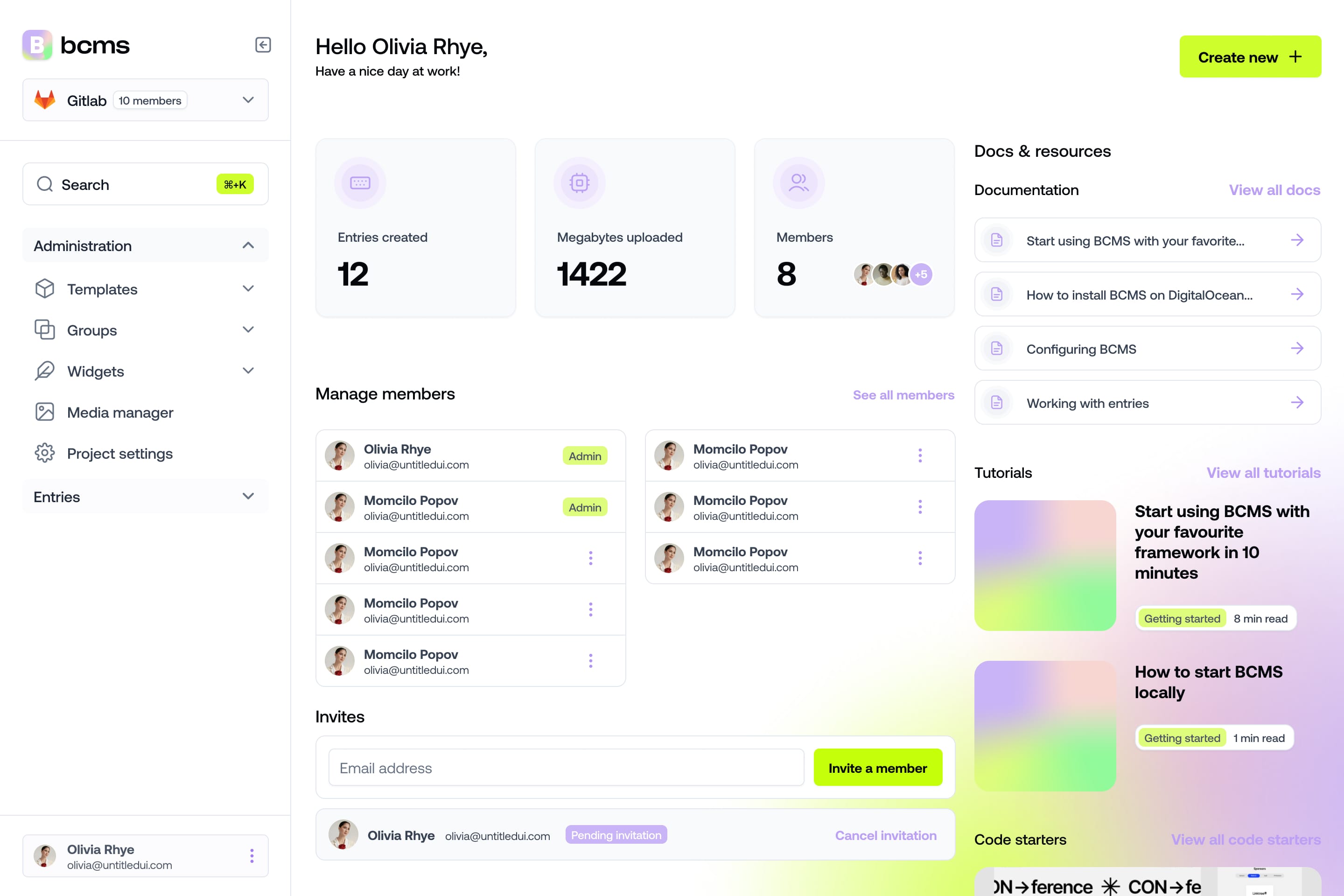
It takes a minute to start using BCMS
14-day free trial · No credit card required
Try BCMS free
Headless CMS for developers. Agents and clients can edit content. You keep the code.
14-day free trial · No credit card required
Try BCMS free
14-day free trial. No credit card. It takes a minute to start using BCMS.
Content
Try BCMS free
Headless CMS for developers. Agents and clients can edit content. You keep the code.
14-day free trial · No credit card required
Continue reading

Mastering Nuxt SEO with headless CMS: A developer's complete guide
Master Nuxt SEO & boost your site's ranking with a headless CMS. This complete guide helps you improve your Nuxt project's SEO effectively.

Nuxt websites: How to build dynamic websites in 2026
Nuxt CMS is a new approach for building Nuxt websites. Learn how to leverage headless CMS for building dynamic Nuxt websites and apps.

CMS for Nuxt: Why to Use It - Guide for Nuxt developers
Nuxt CMS: Why to Use It- Keep reading and discover the full potential of Nuxt CMS for your web development projects.